Medicine Show, Huntingdon, Tennessee (October 1935)
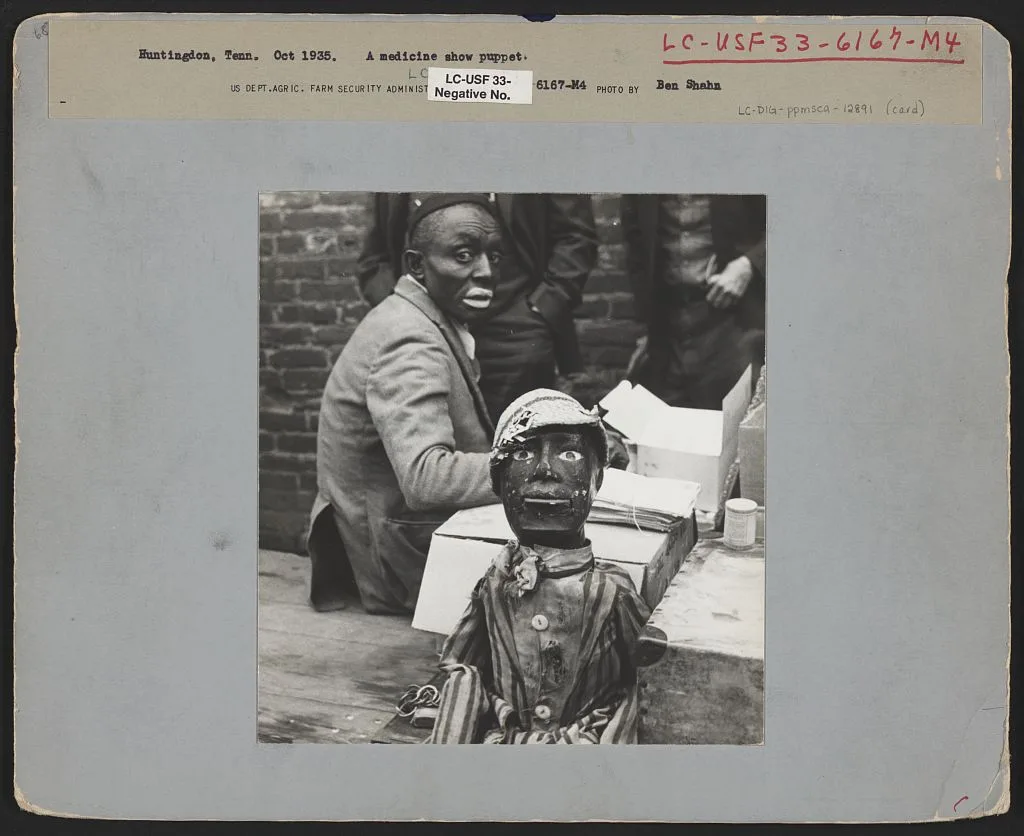
On a Saturday in October 1935 Ben Shahn photographed a traveling medicine show in the town square of Huntingdon, Tennessee. The frame in this archive shows a Black performer in minstrel-style makeup seated behind a ventriloquist's dummy carved as a racial caricature. It is a record of one of the last survivals of a nineteenth-century form of entertainment, and of the minstrel conventions that came with it.
- Date
- October 1935
- Place
- Huntingdon, Tennessee
- Medium
- 35mm nitrate negative; the Library of Congress also holds the original mounted file print
- Collection
- Library of Congress, FSA/OWI Collection, LOT 1473; LC-USF33-006167-M4
- Digital files
- LC-DIG-fsa-8a16825 (from the negative); LC-DIG-ppmsca-12891 (from the file print)
- Also known as
- A medicine show puppet; Tennessee medicine show (Ben Shahn, 1935)
What a medicine show was
The traveling medicine show was a major form of American popular entertainment from about 1870 until the First World War. A troupe arrived in town, often announced by a parade, and performed for free or for very little from a wagon or a street stand. According to the St. James Encyclopedia of Popular Culture, "Entertainment composed two-thirds of a two hour show"; the rest was the sales pitch, delivered by a self-styled doctor selling tonics and liniments that were usually harmless mixtures of herbs, alcohol and sugar. Shows played either from a wagon, the "high pitch," or from a portable stand on the street, the "low pitch." Musicians, jugglers, comedians and minstrel performers made up the bill, and some shows used blackface comedy. Caricature was built into the business in other ways too: the well-known Kickapoo Indian Medicine Company hired Native American performers, often leased through Indian agents on reservations.
The automobile, the movies and the Pure Food and Drug Act of 1906 pushed the form into decline by about 1920, though the form sputtered on into the 1950s and, according to the same encyclopedia, the last show left the road in 1964. The Food, Drug, and Cosmetic Act of 1938, passed three years after Shahn's visit, added harsher penalties for fake medicines. By 1935, when Shahn saw this one, it was already a holdover from an earlier America.
Shahn's memory of the day
Nearly thirty years later Shahn still remembered it. He told the interviewer Richard Doud in 1964 that he had made a series of photographs on a Saturday afternoon in a small town in Tennessee of a medicine man who worked with a ventriloquist's dummy and a Black assistant. What struck him most was how far back in time the scene seemed: "I don't think there were ten cars in the square, they were all mule drawn carts that had come there." And then: "This was 1935; it was incredible you see." The Library of Congress caption card names the town as Huntingdon and dates the negative October 1935.
What the photograph shows
The frame is tightly composed. In the foreground sits the ventriloquist's figure in a striped jacket and battered cap, its carved face painted with the exaggerated features of minstrel caricature. Just behind it a Black man in a jacket and cap sits looking straight toward the camera; his mouth is outlined in pale makeup in the minstrel style. Cardboard boxes and a small tin sit on a table beside him, a brick wall closes off the background, and the legs and coats of onlookers stand at the top edge of the picture.
The typed caption on the original mounted print, visible in one of the Library of Congress scans, calls the picture "A medicine show puppet." The caption does not name the man, and it is not clear from the records whether he is the medicine man Shahn remembered or his assistant.
Reading the picture today
The photograph can be uncomfortable to look at, and that is part of its value as a document. Minstrel conventions, in which Black people were mocked through painted faces and exaggerated features, were part of the medicine-show tradition, and here a Black performer works inside that tradition to earn a living. Shahn puts the man's face and the dummy's face next to each other and at nearly the same height, so that the viewer has to compare the living person with the caricature. The performer's direct, unsmiling look at the lens is the most striking thing in the frame. Shahn usually worked with an angle finder on his Leica so that people would not realize they were being photographed; here, whether or not the man saw the lens, he meets the camera's gaze.
Shahn's own words about the scene use the vocabulary of his time; this page paraphrases them rather than repeating the period term.
Versions and which one this archive holds
This archive holds the Library of Congress record for Medicine show, Huntingdon, Tennessee (item 2017730590), negative number LC-USF33-006167-M4.
Shahn made more than one exposure that afternoon. Harvard Art Museums, whose Fogg Museum holds more than 5,000 of Shahn's photographs given by his widow, Bernarda Bryson Shahn, catalogues prints titled Untitled (medicine show, Huntingdon, Tennessee), such as P1970.1411, dated October 1935. This archive holds only the one frame described here.
Frequently asked questions
What is a medicine show?
A traveling show, common from about 1870 to the First World War, that drew crowds with free music, comedy and variety acts and then sold patent remedies. Rural shows lingered into the 1950s.
When did Ben Shahn photograph the Huntingdon medicine show?
The Library of Congress dates the negative to October 1935, during Shahn's first trip through the South for the Resettlement Administration. Shahn recalled that it was a Saturday afternoon.
Who is the man in Ben Shahn's medicine show photograph?
He is not named in the records. Shahn remembered a medicine man with a ventriloquist's dummy and a Black assistant, but the caption does not say which role this performer had.
Why does the photograph show minstrel makeup?
Medicine shows borrowed heavily from minstrelsy, including blackface comedy. The photograph records that racist convention as it still existed in a small Southern town in 1935.
Sources
- Medicine show, Huntingdon, Tennessee (Library of Congress, item 2017730590)
- Interview with Ben Shahn by Richard K. Doud, April 14, 1964, Archives of American Art New Deal and the Arts Project (transcript reprinted by American Suburb X)
- Louis Scheeder, Medicine Shows, St. James Encyclopedia of Popular Culture (Encyclopedia.com)
- Untitled (medicine show, Huntingdon, Tennessee), P1970.1411 (Harvard Art Museums)
- In the Streets and in the Studio: Ben Shahn's New York (Harvard Magazine, 2000)